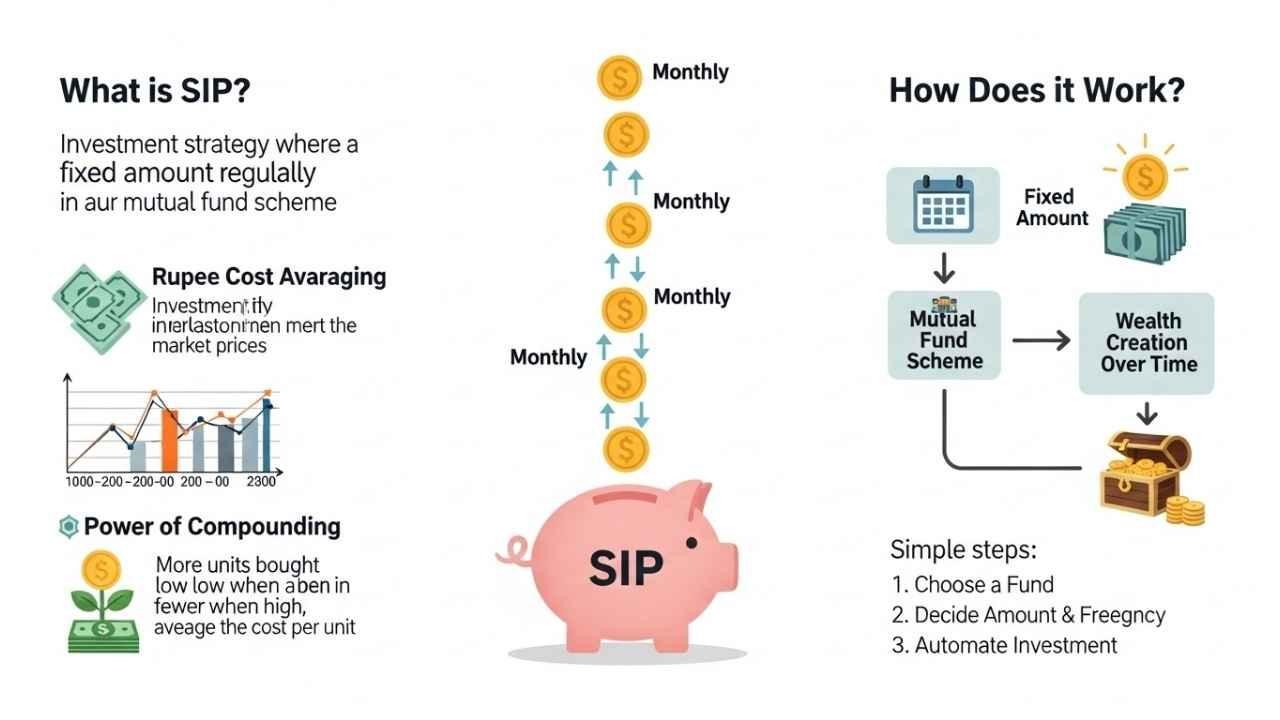
Starting your investment journey can feel overwhelming, especially when you’re trying to figure out how to build wealth without having a large sum of money to invest upfront. This is where a Systematic Investment Plan (SIP) comes to the rescue.
SIP stands for Systematic Investment Plan, and it’s one of the most beginner-friendly ways to invest in mutual funds. Think of it as a recurring deposit for mutual funds – you invest a fixed amount regularly (usually monthly) instead of putting in a large lump sum all at once.
With SIPs, you can start building wealth with amounts as small as ₹100 to ₹500 per month, making it accessible to everyone regardless of their income level. The beauty of SIP lies in its simplicity: once you set it up, your chosen amount gets automatically invested in your selected mutual fund scheme every month, helping you develop a disciplined investment habit without any hassle.
What is SIP?
A Systematic Investment Plan (SIP) is a method of investing in mutual funds in a disciplined manner. Instead of investing a lump sum at once, SIP allows you to invest a small fixed amount regularly (monthly, quarterly, or even weekly).
A SIP allows you to invest a fixed amount of money, say ₹500 or ₹1000, at regular intervals (usually monthly) into a mutual fund scheme. Instead of trying to time the market (which is really hard!), you invest consistently, no matter if the market is up or down.
Key takeaway: SIP is a disciplined approach to investing a fixed sum regularly into mutual funds.
How Does a SIP Work?
It’s actually quite simple! Here’s a step-by-step look:
- Choose a Mutual Fund: First, you’ll need to select a mutual fund scheme that suits your financial goals and risk appetite. There are many types of mutual funds, like equity funds (which invest in stocks), debt funds (which invest in bonds), and balanced funds. You can get advice from a financial advisor in Kolkata to help you choose the right one.
- Decide Your Investment Amount: You pick how much you want to invest regularly. This could be as little as ₹100 or ₹500, making it accessible for almost everyone.
- Set the Frequency: Most people choose monthly SIPs, but you can also opt for quarterly or even weekly investments.
- Automate Your Investment: This is the best part! You link your bank account, and the fixed amount you chose is automatically deducted and invested on a specific date each month. You don’t have to remember to do it manually!
- Buy Units: When you invest through SIP, you are essentially buying “units” of the mutual fund. The price of these units changes daily. Since you invest regularly, you buy more units when prices are low and fewer units when prices are high.
Benefits of SIP
SIP is not just about investing money—it’s about building financial discipline. Let’s look at some major benefits:
- Financial Discipline – Just like paying your monthly bills, SIP helps you stay consistent with your investments.
- Compounding Effect – The biggest magic of SIP is compounding. The earlier you start, the more wealth you can create.
- Diversification – Through mutual funds, your money is spread across different sectors and stocks, reducing risk.
- No Market Timing Needed – Since you invest regularly, you benefit from both rising and falling markets without worrying about timing.
- Achieves Long-Term Goals – Whether it’s retirement, children’s education, or buying a house, SIP helps you reach your financial goals.
Think of SIP as planting a seed today and letting it grow into a tree that gives you shade and fruits for life.
Types of SIPs
SIPs are not one-size-fits-all. There are different types to suit different needs:
- Regular SIP – Fixed amount invested at regular intervals.
- Top-up SIP – You can increase your SIP amount periodically (e.g., increase ₹500 every year).
- Flexible SIP – Lets you change the SIP amount based on your financial situation.
- Perpetual SIP – No end date; continues until you stop it manually.
This flexibility ensures that SIP can fit into anyone’s financial journey.
How to Start SIP in Mutual Funds
Starting a SIP is simple and can be done online in just a few steps:
- Set a Goal – Decide why you’re investing (retirement, home, education, etc.).
- Select a Fund – Choose a mutual fund based on your goal, risk appetite, and time horizon.
- Complete KYC – Submit your PAN card, Aadhaar, and bank details (can be done online).
- Register and Start SIP – Choose the amount, date, and frequency of investment.
- Track Performance – Review your SIP regularly, but don’t panic about short-term market movements.
With online platforms and apps, starting SIP has become as easy as ordering food online.
Common Mistakes to Avoid in SIP Investment
Even though SIP is simple, many investors make mistakes:
- Stopping SIP Too Early – Many stop investing when markets fall, but that’s the best time to continue.
- Investing Without a Goal – Random investments without goals may not bring desired results.
- Checking Returns Daily – SIP is for the long term; avoid worrying about short-term market changes.
- Ignoring Fund Performance – While patience is key, you must still review your fund once a year.
Avoiding these mistakes can make your SIP journey smooth and rewarding.
Tax Benefits of SIP
SIP investments can also help in tax savings if you choose the right type of fund:
- ELSS (Equity Linked Savings Scheme) – Offers tax deduction under Section 80C (up to ₹1.5 lakh per year).
- Long-Term Capital Gains (LTCG) Tax – Gains up to ₹1 lakh per year are tax-free; above that, taxed at 10%.
So, SIP not only grows your wealth but can also help you save taxes.
SIP Calculator and How It Helps
A SIP calculator is an online tool that helps you estimate how much wealth you can create through SIP.
You just enter:
- Monthly investment amount
- Duration (years)
- Expected return rate
And it shows your maturity amount. This helps you plan your goals better and stay motivated.
Conclusion
SIP (Systematic Investment Plan) is one of the easiest and smartest ways to invest in mutual funds. It requires small, regular investments and gives the benefit of compounding, rupee cost averaging, and financial discipline. Whether you’re a beginner or an experienced investor, SIP can help you achieve your financial goals with ease.
The best time to start a SIP was yesterday. The second-best time is today. So, don’t wait—start your SIP journey now and let your money work for you.
Learn More:
- Difference Between Mutual Funds and Stocks – Which is Better for Beginners?
- Understanding NAV (Net Asset Value) in Mutual Funds – What It Means and Why It Matters
- How to Start Investing in Mutual Funds in India – Step-by-Step Process for Beginners
FAQs
1. What is the minimum amount required to start a SIP?
You can start a SIP with as little as ₹500 per month.
2. Can I stop my SIP anytime?
Yes, SIP is flexible. You can stop, pause, or modify it whenever you want.
3. Is SIP risk-free?
No, SIP invests in mutual funds, which are market-linked. But risks are lower compared to lump sum investments.
4. How long should I continue SIP?
The longer, the better. Ideally, you should stay invested for at least 5–10 years.
5. Which SIP is best for tax saving?
ELSS (Equity Linked Savings Scheme) SIPs offer tax benefits under Section 80C.