
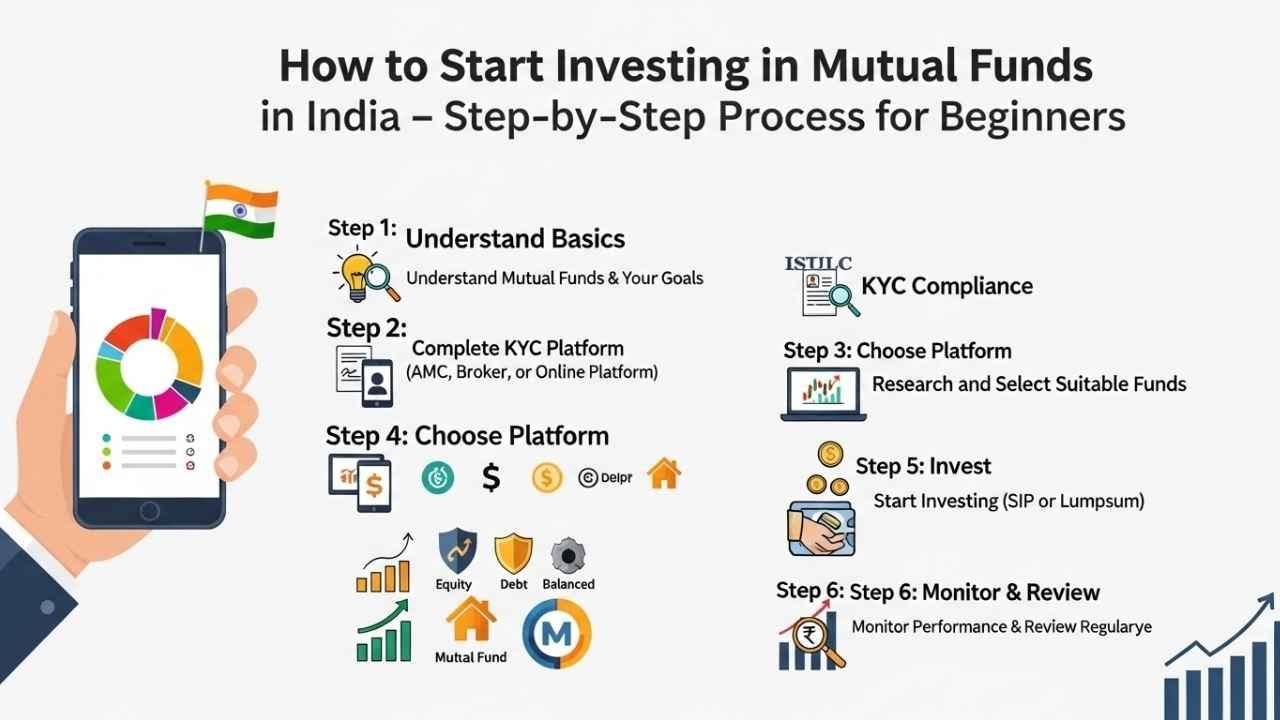
Starting your mutual fund journey in India doesn’t have to be confusing. This simple guide will take you through all the information you require to get started, invest, and create wealth for your future objectives.
What Are Mutual Funds?
Mutual funds are investment schemes stocks, bonds, and other securities. Think of it as a basket where everyone puts their money, and a professional fund manager uses this money to invest in various assets. When these investments make profits or losses, all investors share them based on how much they invested.
Why Should You Invest in Mutual Funds?
- Professional Management: Expert fund managers handle all investment decisions for you. You don’t need to be a stock market expert to invest.
- Diversification: Your money gets spread across many different stocks and bonds, reducing risk. If one company performs poorly, others might do well.
- Low Investment Amount: You can start investing with as little as ₹100 or ₹500 per month through SIP.
- Tax Benefits: ELSS (Equity Linked Savings Scheme) mutual funds offer tax deductions up to ₹1.5 lakh under Section 80C.
- Liquidity: You can buy or sell your mutual fund units on any business day.
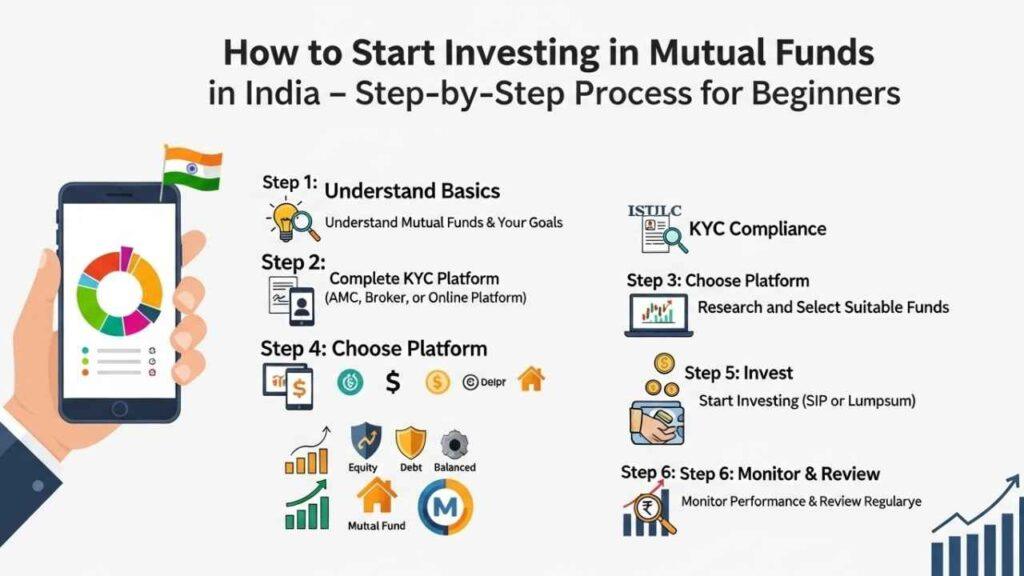
Step 1: Complete Your KYC (Know Your Customer) Documentation
Before investing in any mutual fund, you must complete KYC, which is mandatory by law.
Documents Required:
- PAN Card (mandatory for all investments)
- Aadhaar Card (for identity and address proof)
- Bank Account Details (for transactions)
- Recent photograph
KYC Process:
- Fill the KYC form with your personal details
- Submit self-attested copies of required documents
- Complete In-Person Verification (IPV) through video call or physical verification
- Wait for approval (usually 2-3 working days)
Important: You can only invest from your own bank account. Third-party investments are not allowed.
Step 2: Understand Different Types of Mutual Funds
Equity Funds
- Invest primarily in stocks (minimum 65% in equity)
- Best for: Long-term goals (5+ years)
- Risk: High risk, high potential returns
Debt Funds
- Invest in bonds and fixed-income securities
- Best for: Conservative investors seeking steady returns
- Risk: Low to moderate risk
Hybrid Funds
- Invest in both stocks and bonds in different proportions
- Best for: Investors wanting balanced risk and returns
- Risk: Moderate risk
Popular Hybrid Fund Types:
- Conservative Hybrid: 10-25% in equity, 75-90% in debt
- Balanced Hybrid: 40-60% in both equity and debt
- Aggressive Hybrid: 65-80% in equity, 20-35% in debt
Step 3: Choose Your Investment Method
SIP (Systematic Investment Plan)
- Invest a fixed amount regularly (monthly/quarterly)
- Minimum: ₹100-₹500 per month
- Benefits: Rupee cost averaging, disciplined investing
- Best for: Beginners and regular income earners
Lumpsum Investment
- Invest a large amount at once
- Minimum: ₹1,000
- Benefits: Potentially higher returns if market timing is right
- Best for: Experienced investors with surplus funds
Step 4: Select the Right Platform
Top Mutual Fund Apps in India 2025
Groww
- Zero commission on direct mutual funds
- User-friendly interface for beginners
- Educational resources available
- Minimum SIP: ₹100
Zerodha Coin
- Focus on direct mutual fund investments
- No commission or hidden charges
- Clean interface
- Best for cost-conscious investors
Paytm Money
- Commission-free direct mutual funds
- Integration with Paytm ecosystem
- Simple app interface
- Good for existing Paytm users
ET Money
- AI-powered investment recommendations
- Comprehensive financial planning tools
- Research-backed suggestions
Step 5: Start Your Investment Process
Online Investment Process:
- Choose a Platform: Select from apps like Groww, Zerodha Coin, or Paytm Money
- Create Account: Sign up with your mobile number and email
- Complete KYC: Upload required documents and complete verification
- Choose Fund: Select mutual fund scheme based on your goals
- Set Investment Amount: Decide between SIP or lumpsum
- Set Auto-debit: Enable automatic bank deduction for SIP
- Start Investing: Place your first order
Offline Investment Process:
- Visit mutual fund company office or authorized distributor
- Submit application form with cheque/bank draft
- Complete KYC documentation
Step 6: Choose the Right Mutual Fund Scheme
Factors to Consider:
- Past Performance: Check 1, 3, and 5-year returns
- Fund Manager Experience: Research the fund manager’s track record
- Expense Ratio: Lower expense ratios mean higher returns for you
- Investment Objective: Ensure it matches your goals
For Beginners: Start with balanced or debt funds for lower risk and steady returns.
Understanding NAV (Net Asset Value)
NAV is the price per unit of a mutual fund. It’s calculated as:
NAV = (Total Assets – Total Liabilities) / Number of Outstanding Units
- NAV is updated daily after market closes
- Your investment amount divided by NAV gives you the number of units
- Example: ₹10,000 investment ÷ ₹15 NAV = 667 units
Tax Benefits and Implications
ELSS Funds for Tax Saving
- Tax Deduction: Up to ₹1.5 lakh under Section 80C
- Lock-in Period: 3 years (shortest among 80C options)
- Tax on Gains: Long-term capital gains above ₹1 lakh taxed at 10%
Important: Only ELSS mutual funds qualify for Section 80C benefits, not other mutual fund types.
Tips for Successful Mutual Fund Investing
- Start Early: The power of compounding works better over longer periods
- Stay Consistent: Continue your SIPs even during market downturns
- Review Regularly: Monitor your investments but avoid frequent changes
- Diversify: Don’t put all money in one fund
- Set Clear Goals: Define what you’re investing for (house, education, retirement)
- Don’t Time the Market: SIPs help average out market volatility
Common Mistakes to Avoid
- Investing without completing KYC
- Choosing funds based only on past performance
- Stopping SIPs during market downturns
- Not reading scheme documents properly
- Investing borrowed money
- Having unrealistic return expectations
Getting Started Today
For Absolute Beginners:
- Download Groww or similar app
- Complete KYC process
- Start with a balanced fund SIP of ₹1,000 per month
- Learn and gradually increase your investment
Remember: Market risks apply to mutual fund investments. Read scheme-related documents carefully before investing. Begin small, be regular, and let compound growth benefit you over a period of time.
Your mutual fund journey starts with a single click. Select a good platform, get your KYC done, and begin investing based on your investment goals and risk tolerance. The sooner you start, the more time your money will have to grow!
Learn More:









hi