Make your credit card work for you – not against you.
What if I told you that you could use your credit card without paying a single rupee in interest? Sounds too good to be true, right?
Well, it’s not. Every credit card comes with something called an “interest-free period” or “grace period.” And if you use it smartly, you can enjoy all the benefits of your credit card – the convenience, the rewards, the flexibility – without ever paying interest.
The problem? Most people don’t know how to use this period properly. They end up paying interest when they could have easily avoided it.
In this blog, we’ll break down exactly what the interest-free period is and share practical tips to help you make the most of it.
What Exactly Is the Interest-Free Period?
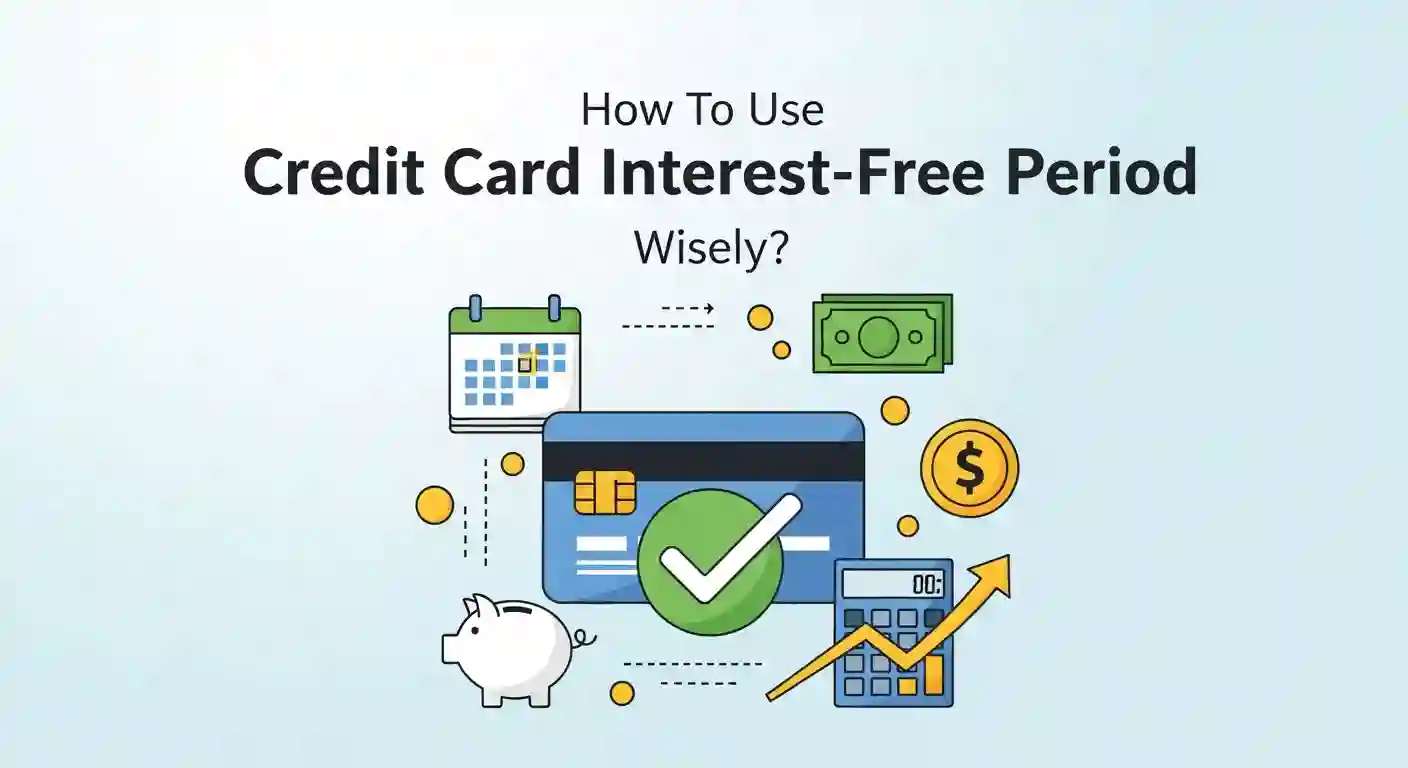
Simply put, the interest-free period is the time between when you make a purchase and when your payment is due. During this window, your credit card company won’t charge you any interest on your transactions.
This period typically ranges from 18 to 55 days, depending on when you make your purchase during the billing cycle.
Here’s the key thing to remember: You only get the interest-free benefit if you pay your entire bill on or before the due date. Pay even a day late or leave even a small balance unpaid, and you’ll be charged interest.
Think of it as a short-term, interest-free loan from your bank. Use it wisely, and it’s a fantastic perk. Use it carelessly, and it can cost you money.
Now, let’s look at how you can take full advantage of this period.
Tips to Use Your Credit Card Interest-Free Period Wisely
1. Plan Your Payments Around the Billing Cycle
This is the golden rule of maximizing your interest-free period. The timing of your purchase matters – a lot.
Let me explain with a simple example.
Let’s say your credit card billing cycle runs from May 5th to June 6th, and your payment due date is around June 25th.
- Scenario A: You buy something on May 6th (right after the cycle starts). You’ll have almost 50 days before your payment is due. That’s 50 days of using the bank’s money for free!
- Scenario B: You buy something on May 20th (middle of the cycle). Now you’ll only have about 35 days until your payment is due.
- Scenario C: You buy something on June 5th (end of the cycle). You’ll have barely 20 days before the bill comes.
See the difference? The same purchase gives you different interest-free periods based on when you make it.
The smart move: Try to make big purchases at the beginning of your billing cycle. This way, you get the maximum time to pay without interest.
Pro tip: Check your credit card statement or app to know exactly when your billing cycle starts and ends. Mark it on your calendar if needed!
2. Always Pay Your Outstanding Balance in Full
This cannot be stressed enough. To enjoy the interest-free period, you must pay the complete outstanding amount by the due date. Not the minimum amount. Not most of it. The full amount.
If you carry forward even a small balance to the next month, the interest-free benefit disappears. You’ll be charged interest not just on the remaining balance, but often on new purchases too.
Here’s a common mistake people make:
Let’s say you have a bill of ₹10,000, and you pay ₹9,500, thinking you’re almost done. That leftover ₹500 will attract interest. And depending on your card’s interest rate (which can be anywhere from 24% to 42% per year), that small amount can grow quickly.
The bottom line: Treat your credit card like a debit card mentally. Only spend what you can afford to pay back in full.
3. Choose Faster Payment Methods
How you pay your bill matters more than you might think.
Let’s say you write a cheque to pay off your credit card debt. The cheque needs to be processed, cleared, and then the amount gets credited to your card. This can take 2-3 business days, sometimes longer.
Now, imagine you send the cheque on the due date. By the time it clears, you’ve technically missed the deadline. Guess what happens? Interest kicks in for those extra days.
A smarter approach: Use digital payment methods instead.
- Internet banking – Transfer the amount directly to your credit card account
- Mobile banking apps – Quick and easy payments from your phone
- UPI payments – Instant transfers in most cases
- Auto-pay – Set up automatic payments so you never miss a due date
These methods ensure your payment reflects almost immediately. No waiting, no worrying, no surprise interest charges.
4. Never Withdraw Cash Using Your Credit Card
Here’s something many credit card users don’t realize: Cash withdrawals don’t get an interest-free period.
When you use your credit card at an ATM to withdraw cash, the rules change completely. Unlike regular purchases, cash withdrawals start attracting interest from day one – from the very moment you take out the money.
On top of that, you’ll also be charged:
- Cash advance fees – Usually 2.5% to 3% of the amount withdrawn
- Interest charges – Typically higher than the interest on purchases
And here’s the worst part: These charges apply even during your grace period. The interest-free benefit simply doesn’t exist for cash withdrawals.
What should you do instead?
If you need cash urgently, consider other options first:
- Transfer money from your savings account
- Use a personal loan if it’s a larger amount
- Borrow from a friend or family member temporarily
Only use the credit card cash withdrawal feature as an absolute last resort. The costs add up faster than you’d expect.
5. Manage Expenses Across Multiple Credit Cards
Do you have more than one credit card? If yes, you have an opportunity to extend your interest-free period even further.
The trick is simple: Use different cards based on their billing cycles.
Here’s an example:
- Card A has a billing date of May 15th
- Card B has a billing date of May 1st
Now, if you need to make a purchase on May 10th, which card should you use?
If you use Card B, the purchase will be included in the current billing cycle (which started May 1st), and your payment will be due soon.
But if you use Card A, the purchase will be included in the next billing cycle (starting May 15th), giving you more time to pay.
The strategy:
- For purchases made before May 15th, use Card B (its cycle is about to end anyway)
- For purchases made after May 15th, use Card A (to catch the beginning of its fresh cycle)
By splitting your expenses smartly, you maximize the interest-free period on both cards. It takes a little planning, but the savings are worth it.
One important note: Don’t open multiple credit cards just for this purpose. Only use this strategy if you already have more than one card and can manage both responsibly.
Common Mistakes to Avoid
Now that you know what to do, let’s quickly cover what not to do:
Mistake #1: Paying only the minimum amount due
Yes, it keeps your account in good standing. But you’ll pay hefty interest on the remaining balance. Always aim to pay in full.
Mistake #2: Ignoring your billing cycle dates
Not knowing when your cycle starts and ends means you can’t plan effectively. Check your statement and note these dates.
Mistake #3: Making large purchases at the end of the billing cycle
You’ll have very little time before payment is due. Time your big spends for the beginning of the cycle.
Mistake #4: Using credit card for cash withdrawals
As we discussed, this is expensive. Avoid it unless absolutely necessary.
Mistake #5: Missing the payment due date
Even by one day. Set up reminders or auto-pay to ensure you never forget.
Quick Recap: Your Interest-Free Period Checklist
Let’s summarize everything with a simple checklist:
- Know your billing cycle start and end dates
- Make large purchases at the beginning of your billing cycle
- Always pay the full outstanding amount
- Pay a few days before the due date, not on the due date
- Use instant payment methods like net banking or UPI
- Avoid cash withdrawals on your credit card
- If you have multiple cards, use them strategically based on their billing dates
- Set up payment reminders or auto-pay
Final Thoughts
However, using a credit card can be a bit daunting. Tales of people being overwhelmed with credit card debt are all around us, and they can be quite frightening. But here’s the thing: credit cards are not the problem. The problem is how you use them.
The interest-free period is actually one of the best things about any credit card. It allows you to manage your finances, deal with unexpected expenses, and even earn rewards without having to pay a single cent extra.
Of course, paying off your entire balance all at once may not always be easy. But life is unpredictable, and things don’t always go as planned. However, with a bit of planning and timing, you can easily avoid paying more than you need to.
The first thing you need to do is understand your billing cycle. Then, plan your purchases accordingly. Pay your bills on time, every time. And avoid making cash withdrawals.
If you do all these, your credit card will become an incredibly powerful financial tool that works for you, not against you.
Learn More:
- How to Transfer Home Loan from One Bank to Another?
- How to Pay Electricity Bill through Credit Card
- How to Increase Credit Card Limit
- Home Loan Benefits for Women in India
- Best Banks for Gold Loan in India 2025
- Get SBI Yono Personal Loans? Helpful Tips to Get the Loan Fast
- 7-step checklist for fast ICICI Bank personal loan approval
- Airtel Payment Bank Loan: How to Get a ₹5,000 Loan in Just Minutes