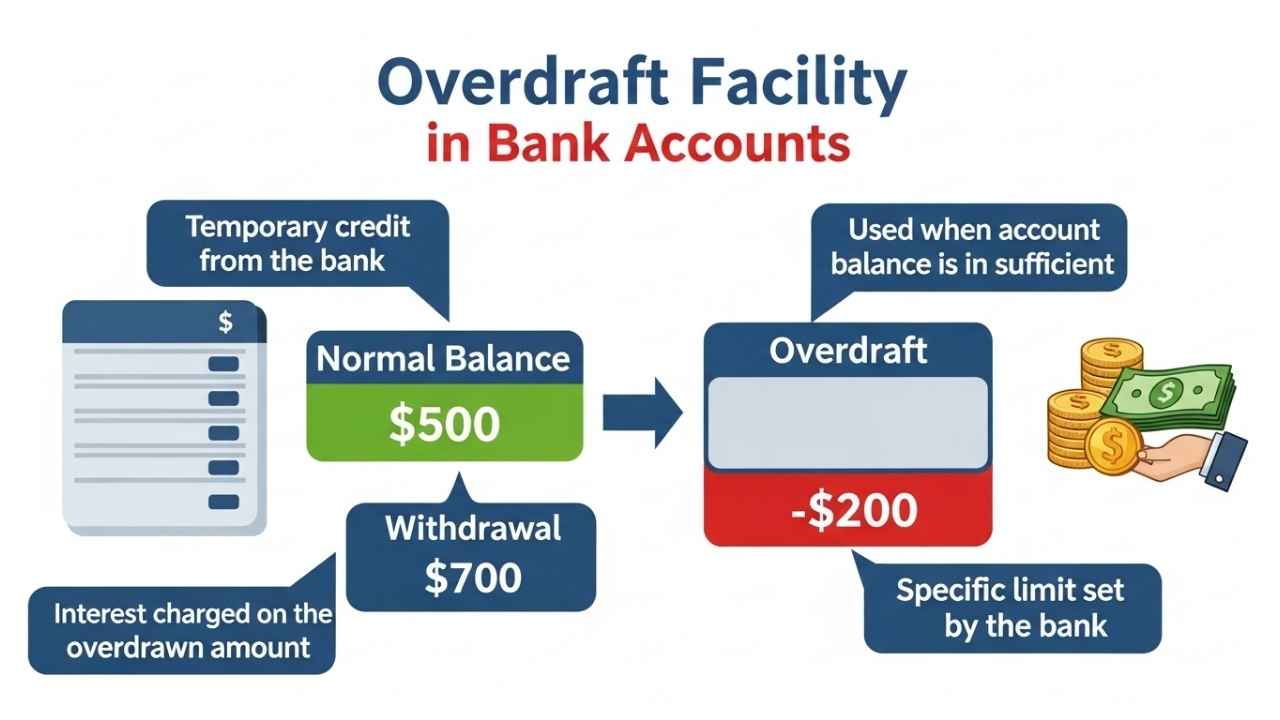
An overdraft facility is a handy banking feature that lets you withdraw more money than what’s available in your account, up to a certain approved limit. It’s like a short-term credit agreement between you and your bank. This facility can be a lifesaver during emergencies or when you need extra cash for a short period.
How Does an Overdraft Facility Work?
When you have an overdraft facility, your bank sets a specific limit. You can withdraw money up to this limit, even if your account balance is zero. The bank charges interest only on the amount you actually use, not on the entire limit. Interest is calculated daily and billed monthly.
If you don’t repay the amount on time, the interest rate may increase. You can repay the amount whenever you have the funds, either as a lump sum or in installments. There’s no prepayment penalty or EMI concept, unlike regular loans.
Features of Overdraft Facility
- Pre-approved Limit: The bank sets a limit based on your account balance, financial stability, and collateral.
- Interest on Used Amount: You pay interest only on the amount you withdraw, not the entire limit.
- Daily Interest Calculation: Interest is calculated daily and billed monthly.
- Flexible Repayment: You can repay the amount as and when you have the funds, with no fixed EMI.
- No Prepayment Penalty: You can repay the amount early without any extra charges.
Types of Overdraft Accounts
Overdraft facilities can be secured or unsecured. Here are some common types:
1. Overdraft Against Salary
Salaried individuals can get an overdraft facility against their monthly income. The limit is usually about two times your salary. You need to have a salary account with the same bank.
2. Overdraft Against House or Property
You can pledge your property as collateral for an overdraft. The limit is typically around 50% of the property’s value.
3. Overdraft Against Fixed Deposits
Fixed deposits can be used as collateral. The process is quick, and the limit can be up to 75% of your fixed deposit value.
4. Overdraft Against Insurance Policies
Insurance policies with a surrender value can be used as collateral. The surrender value is the amount you get if you terminate the policy before maturity.
5. Overdraft Against Equity Investments
Equity investments can be used as collateral, but the limit is usually lower due to market fluctuations.
Bank Accounts Eligible for Overdraft Facility
Overdraft facilities are available for various types of bank accounts:
- Current accounts
- Salary accounts
- Savings accounts
- Deposit accounts
Process of Applying for an Overdraft Facility
Some bank account holders are pre-approved for an overdraft facility. If you’re not pre-approved, you can apply online or at your bank branch. The application process is quick, and the bank will assess your eligibility based on your financial stability and collateral.
Difference Between Overdraft Account and Personal Loan
| Feature | Overdraft Account | Personal Loan |
|---|---|---|
| Type | Line of credit | Loan |
| Repayment | Flexible, no EMI | Fixed EMI |
| Interest | Only on used amount, daily calculation | On entire loan amount, monthly calculation |
| Prepayment Penalty | None | May apply |
Final Thoughts
An overdraft facility is a flexible and convenient way to manage short-term financial needs. However, it’s important to use it responsibly. While it can be a blessing in emergencies, misusing it can lead to financial trouble and affect your credit score. Always spend prudently and repay the amount as soon as possible to avoid extra charges.
Learn More:
- How to Increase Credit Card Limit
- Home Loan Benefits for Women in India
- Best Banks for Gold Loan in India 2025
- Get SBI Yono Personal Loans? Helpful Tips to Get the Loan Fast
- 7-step checklist for fast ICICI Bank personal loan approval
- Airtel Payment Bank Loan: How to Get a ₹5,000 Loan in Just Minutes