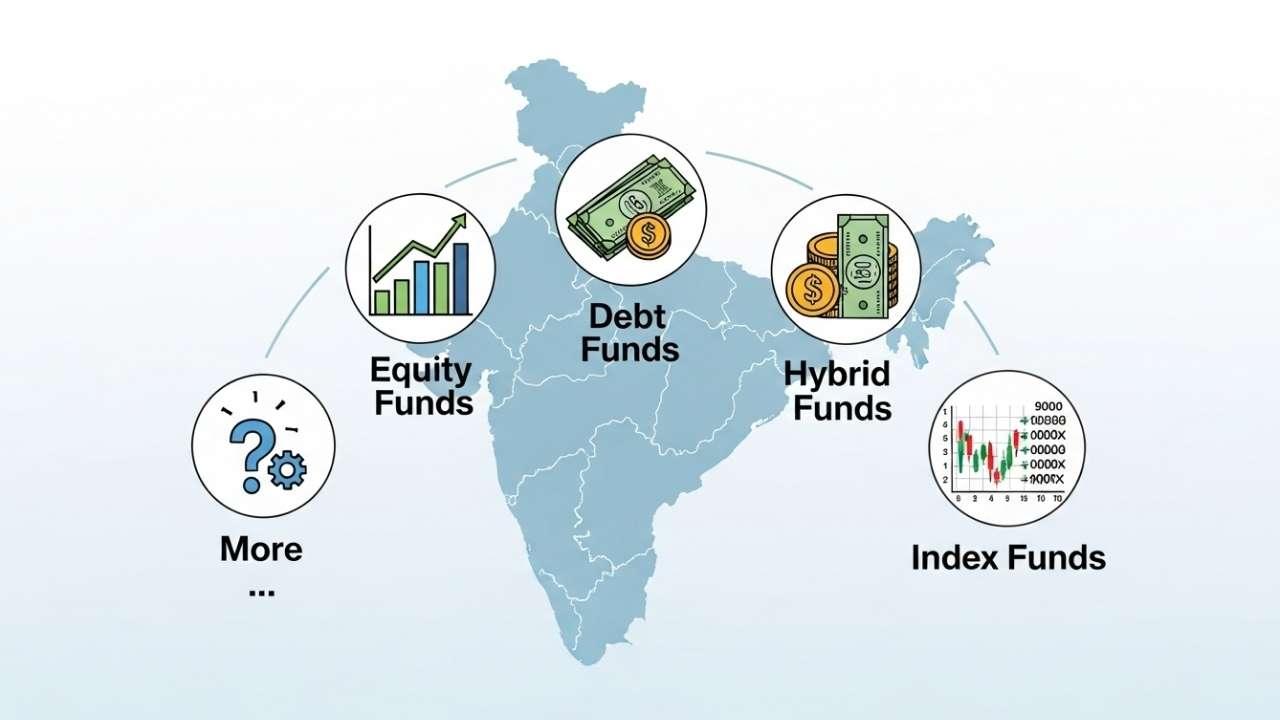
Choosing the right mutual fund can seem overwhelming with so many options available in the Indian market. Understanding the different types of mutual funds and their characteristics will help you make informed investment decisions that align with your financial goals and risk tolerance.
Types of Mutual Funds in India
Mutual funds are now one of India’s most popular investment options, with the industry managing assets worth over ₹55 lakh crore. The Securities and Exchange Board of India (SEBI) has categorized mutual funds into five main groups to bring clarity and standardization:
- Equity Schemes
- Debt Schemes
- Hybrid Schemes
- Solution-Oriented Schemes
- Other Schemes
Each category serves different investor needs, from aggressive creation of wealth to risk-free capital preservation.
Whether you’re a beginner looking to start your investment journey or an experienced investor seeking to diversify your portfolio, understanding these fund types will help you choose the most suitable options for your financial objectives.
1. Equity Mutual Funds
Equity mutual funds are the growth engines of the mutual fund universe. These funds invest at least 65% of their assets in stocks and equity-related instruments. They are designed for investors who want to build long-term wealth and can tolerate market volatility.
Equity funds work by pooling money from multiple investors and investing it across various stocks of different companies. Professional fund managers select stocks based on extensive research and analysis, aiming to generate returns that beat inflation and create substantial wealth over time.
The power of equity funds lies in their ability to participate in the growth story of Indian companies and the overall economy.
Types of Equity Funds
- These funds are further categorized based on market capitalization:
- Large Cap Funds – Investing in top 100 companies
- Mid Cap Funds – 101st to 250th largest companies
- Small Cap Funds – Companies ranked 251st onwards
- Multi Cap Funds – Flexible allocation across all market caps
Each sub-category offers different risk-return profiles, with small cap funds being the most volatile but potentially offering the highest returns.
Equity funds are ideal for investors with a high risk appetite and investment horizon of 5+ years. They suit:
- Young professionals
- Individuals saving for retirement
- Anyone looking to build substantial wealth over the long term
However, investors should be prepared for short-term volatility and market fluctuations.
2. Debt Mutual Funds
Debt mutual funds are the stability providers in your investment portfolio. These funds primarily invest in fixed-income securities like government bonds, corporate bonds, treasury bills, commercial papers, and certificates of deposit.
Debt funds work by lending money to governments and corporations in exchange for regular interest payments. The fund manager selects securities based on:
- Credit quality
- Interest rate outlook
- Duration to optimize returns while managing risk
These funds are less volatile than equity funds and provide more predictable returns, making them suitable for conservative investors or those with shorter investment horizons.
Types of Debt Funds
The debt fund category includes various types based on maturity period:
- Overnight Funds – Lending for one day
- Ultra Short Duration Funds – 3-6 months
- Short Duration Funds – 1-3 years
- Medium Duration Funds – 3-4 years
- Long Duration Funds – More than 7 years
Debt funds are perfect for conservative investors seeking steady returns with lower risk. They suit:
- Individuals nearing retirement
- Those with short to medium-term goals (1-3 years)
- Investors who want to park emergency funds while earning better returns than savings accounts
Important Note: Post-2023 tax changes have made debt funds less attractive as gains are now taxed according to income tax slabs.
3. Hybrid Mutual Funds
Hybrid mutual funds offer the best of both worlds by investing in a combination of equity and debt securities. These funds aim to provide balanced growth and income while reducing overall portfolio risk through diversification across asset classes.
Hybrid funds work by dynamically or statically allocating investments between stocks and bonds based on the fund’s investment mandate. This balanced approach helps:
- Smooth out volatility typically associated with pure equity funds
- Offer better growth potential than pure debt funds
- Allow fund managers to adjust allocation based on market conditions
SEBI Classification of Hybrid Funds
SEBI has classified hybrid funds into seven sub-categories:
- Conservative Hybrid Funds – 10-25% equity, 75-90% debt
- Balanced Hybrid Funds – 40-60% in both equity and debt
- Aggressive Hybrid Funds – 65-80% equity, 20-35% debt
- Dynamic Asset Allocation Funds – Flexible 0-100% allocation
- Multi Asset Allocation Funds – Minimum 10% in at least 3 asset classes
- Arbitrage Funds – Exploit price differences
- Equity Savings Funds – Minimum 65% equity plus derivatives for hedging
Hybrid funds are ideal for moderate risk investors with 3-5 year investment horizons. They suit:
- First-time mutual fund investors
- Those approaching retirement who want some equity exposure
- Investors who prefer professional asset allocation management
4. Index Funds
Index funds are the passive investment champions that aim to replicate the performance of specific market indices like Nifty 50 or Sensex. Instead of trying to beat the market, these funds simply track their benchmark index.
Index funds work on the principle of passive management, where the fund manager doesn’t actively select stocks but mechanically follows the index composition. When the index adds or removes stocks, the fund makes corresponding changes.
Key Advantages
- Lower expense ratios (typically 0.1-0.5% vs 1-2% for actively managed funds)
- Transparency (you know exactly what you’re investing in)
- Consistency (no style drift or manager risk)
Limitations
- They will never outperform the market
- May underperform during certain market conditions where active management could add value
Index funds are perfect for passive investors who believe in long-term market growth. They suit:
- Beginners wanting simple, low-cost market exposure
- Investors who don’t want to worry about fund manager selection
- Those who prefer a hands-off investment approach
- Particularly suitable for systematic investment plans (SIPs) over long periods
5. ELSS (Equity Linked Savings Scheme) Funds
ELSS funds are equity mutual funds with a unique tax-saving feature. They invest at least 80% of their assets in equity and equity-related instruments while offering tax deductions under Section 80C of the Income Tax Act.
ELSS funds work like regular equity funds but come with a mandatory three-year lock-in period. This lock-in period ensures that investors stay invested through market cycles, potentially leading to better returns.
Tax Benefits
- Tax Deduction: Up to ₹1.5 lakh annually under Section 80C
- Tax Savings: Up to ₹46,800 for investors in the highest tax bracket
- Post Lock-in: Long-term capital gains up to ₹1 lakh are tax-free
- Above ₹1 lakh: Gains taxed at just 10%
Advantages
What makes ELSS funds particularly attractive is their dual benefit of wealth creation and tax savings. Unlike other Section 80C instruments:
- PPF: 15-year lock-in
- NSC: 5-year lock-in
- ELSS: Shortest 3-year lock-in with potentially higher returns
ELSS funds are ideal for taxpayers looking to save taxes while building long-term wealth. They suit:
- Salaried individuals in higher tax brackets
- Young professionals combining tax planning with wealth creation
- Anyone looking for the most efficient tax-saving investment under Section 80C
Note: Investors should be prepared for equity market volatility and commit to the three-year lock-in period.
6. Sectoral and Thematic Funds
Sectoral Funds
Sectoral funds are specialized equity funds that invest at least 80% of their assets in a single sector like banking, IT, pharmaceuticals, or infrastructure. These funds provide concentrated exposure to specific industries and their growth prospects.
Sectoral funds focus entirely on one sector, allowing investors to benefit from the growth of that particular industry. For example:
- Banking Sector Fund – Only invests in banks and financial institutions
- Pharma Fund – Focuses on pharmaceutical and healthcare companies
This concentrated approach can lead to exceptional returns when the sector performs well but can also result in significant losses during sector downturns.
Thematic Funds
Thematic funds take a broader approach by investing across multiple sectors that align with a common theme or trend. Examples include:
- Digital India Fund – IT, telecom, fintech, and e-commerce companies
- ESG Fund – Companies with good environmental, social, and governance practices
This provides better diversification than sectoral funds while maintaining a focused investment strategy.
- Sectoral funds: Suitable for expert investors with deep sector knowledge and high risk tolerance
- Thematic funds: Better for investors who believe in long-term trends but want slightly better diversification
Both types require:
- Significant research
- Active monitoring
- Should form only a small portion of a diversified portfolio
7. Solution-Oriented Funds
Solution-oriented funds are goal-specific mutual funds designed to help investors achieve particular life objectives like retirement planning or children’s education and marriage expenses. These funds come with a mandatory five-year lock-in period to ensure long-term wealth creation.
Solution-oriented funds work by aligning investment strategy with specific financial goals:
Retirement Funds
- Gradually shift allocation from equity to debt as investor approaches retirement age
- Follow a life-cycle approach
Children’s Funds
- Designed to accumulate wealth for future education and marriage expenses
- Typically maintain higher equity allocation for long-term growth
Key Benefits
- Disciplined, goal-focused investing with professional management
- Tailored to specific life events
- Mandatory lock-in prevents premature withdrawals
- Helps investors stay committed to long-term goals
- Fund managers adjust asset allocation based on time horizon and risk profile
Solution-oriented funds are perfect for goal-specific investors who want professional help in planning for major life events. They suit:
- Parents planning for children’s future expenses
- Individuals starting retirement planning
- Anyone who prefers a structured approach to goal-based investing
Important: The five-year lock-in makes them suitable only for investors with clear long-term financial objectives.
Conclusion
Understanding the different types of mutual funds available in India empowers you to make informed investment decisions that align with your financial goals, risk appetite, and investment horizon. From aggressive equity funds for long-term wealth creation to conservative debt funds for stability, each fund type serves a specific purpose in your investment portfolio.
Your financial journey begins with understanding these fund types and making informed choices based on your unique circumstances.
Disclaimer: This article is for educational purposes only and should not be considered as financial advice. Please consult with a qualified financial advisor before making investment decisions. Mutual fund investments are subject to market risks. Read all scheme-related documents carefully.
Learn More: